Built for housing teams
Your time is money. Stop wasting both.
The platform that gives your team back the hours they spend chasing, logging, and following up.
Book a demo
£1,500
Avg saving per plot
65%
Issues resolved in-app
620+
Admin hours saved

7 days
Avg onboarding time
£1,500
Avg saving per plot
65%
Issues resolved in-app
620+
Admin hours saved
7 days
Avg onboarding time
£1,500
Avg saving per plot
65%
Issues resolved in-app
620+
Admin hours saved
7 days
Avg onboarding time
Industry Validation
What the industry said when they saw it

Automation is long overdue in this sector. This will be a gamechanger.

Having all these features in one system will save so much time, money and resource.

You have got something the industry really needs.

This will help us, our buyers and our sub-contractors all at once.
Most tools in this space were built for one team, one stage, or one problem. Ubrix covers the whole delivery chain, onboards in days, and every team that picks it up says the same thing: it just makes sense.




What is Ubrix
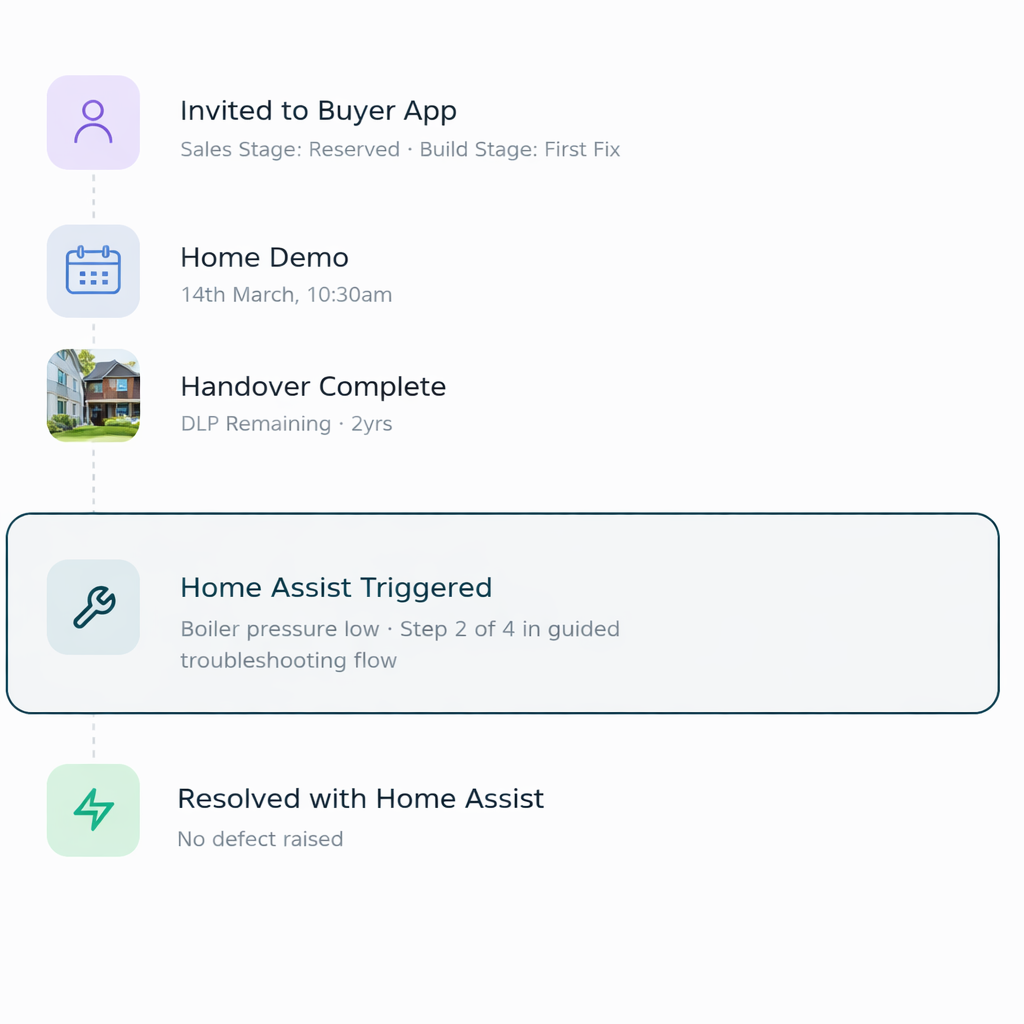
Every plot, every stage, one record of truth
Sales, compliance, and aftercare joined up from reservation to the end of the defects period. Built for housebuilders, principal contractors, housing associations, and local authorities.
Works the way your team already works
Configure rules, roles, and approvals to match how you already operate.
Scales from one site to hundreds
Same platform, same workflows, one site or a hundred.


Live in days, not months
Most teams are live within a week, no lengthy setup needed.
Smart Triage
Confirm & Create

Every issue captured, nothing slips through
Snag reports and aftercare emails are filed and organised automatically.

Built on your numbers
620 hours of admin saved per 150 plots, modelled on a typical new-build scheme.
Ubrix feature suite
Get to know Ubrix
A connected set of tools that replace disconnected systems, spreadsheets, inboxes, and workarounds your team relies on today.
Buyer App & Home Assist
Keep buyers informed and supported from reservation to resolution.
Learn moreContractor Hub
One place for contractors to see jobs, update progress, and sign off work.
Learn moreBREL & Compliance
Compliance records built in as you go, auditable and ready when needed.
Learn moreBuilt for every team in the delivery chain.
Whether you're selling plots, managing subcontractors or maintaining homes, Ubrix is designed around how your team actually works.
See all features →House Builders
Keep plots moving. Keep completions on track.
Ubrix tracks every milestone, sign-off and issue across your whole pipeline so nothing stalls and no completion creeps up on you.
How it works for house builders →
Principal Contractors
Every stage signed off. Every decision on record.
Stage checks, BREL compliance, snagging and submissions in one place. Your client stays updated as work progresses.
How it works for principal contractors →
Housing Associations & Local Authorities
Respond faster. Prove you did.
Ubrix gives your team one place to manage repairs, track progress and show residents their issue is being dealt with.
How it works for housing teams →
House Builders
Keep plots moving. Keep completions on track.
Ubrix tracks every milestone, sign-off and issue across your whole pipeline so nothing stalls and no completion creeps up on you.
How it works for house builders → Principal Contractors
Every stage signed off. Every decision on record.
Stage checks, BREL compliance, snagging and submissions in one place. Your client stays updated as work progresses.
How it works for principal contractors → Housing Associations & Local Authorities
Respond faster. Prove you did.
Ubrix gives your team one place to manage repairs, track progress and show residents their issue is being dealt with.
How it works for housing teams → Built for every team
One platform, every role
 Senior Leadership
 Senior Leadership
Full visibility across every development, every team, every metric in one place
 Sales
Sales Sales
Every plot, every buyer, every milestone tracked from reservation to completion
 Site
Site Site
Live build stage progress and compliance visibility without chasing updates
 Customer Care
 Customer Care
Every incoming issue triaged, routed and tracked automatically
 Commercial
 Commercial
Full pipeline and contract visibility across every active development
 Development Management
 Development Management
Oversee programmes, teams and delivery across your entire portfolio
Estimate your savings
See what Ubrix could save your team
Figures are directional and based on typical new-build volumes. Adjust the inputs to reflect your operations.
Estimated value saved
£8,505
per year, at £35 / hour average
243
Hours saved per year
3.0%
Directional NOI uplift
Figures are directional only and exclude contractor costs.
Flexible pricing
Only pay for the plots you manage
Free to start. No credit card required.
Every plan includes the full Ubrix feature suite. Integrations are discussed during contract negotiations.
Starter
1 - 10 plots
Free while you get started.
- Buyer App and Home Assist
- Smart Triage
- Auto-Assign
- Build programme management
- BREL and compliance management
- Sales journey and plot management
- Site App
- Contractor Hub
- Aftercare and defect management
- Reporting and integrations
- AI solutions
Growth
11 - 1,000 plots
For housebuilders and contractors scaling up.
- Buyer App and Home Assist
- Smart Triage
- Auto-Assign
- Build programme management
- BREL and compliance management
- Sales journey and plot management
- Site App
- Contractor Hub
- Aftercare and defect management
- Reporting and integrations
- AI solutions
Scale
1,001 - 2,000 plots
Best value for multi-site teams.
- Buyer App and Home Assist
- Smart Triage
- Auto-Assign
- Build programme management
- BREL and compliance management
- Sales journey and plot management
- Site App
- Contractor Hub
- Aftercare and defect management
- Reporting and integrations
- AI solutions
Enterprise
2,000+ plots
Built for organisations managing up to 4,000+ plots.
- Buyer App and Home Assist
- Smart Triage
- Auto-Assign
- Build programme management
- BREL and compliance management
- Sales journey and plot management
- Site App
- Contractor Hub
- Aftercare and defect management
- Reporting and integrations
- AI solutions
The platform built for how new-build housing actually works.
Try it free for up to 10 plots. No credit card required.