
The problem right now
Ask any customer care director how long it takes to build a full case file when an NHQC complaint lands, and the honest answer is rarely comfortable. The buyer's original reservation details sit in one system. Snagging records from the pre-completion inspection live in a spreadsheet or a PDF buried in someone's inbox. Post-completion correspondence is scattered across Outlook threads, WhatsApp messages and handwritten notes from site managers who have since moved on. Pulling all of that into a single, defensible record is not a five-minute task. It is a two-day scramble that pulls your aftercare team away from the defects they should be resolving.
This is not a niche problem. It is the default operating model for a significant number of UK housebuilders. The data exists, but it is fragmented across systems that were never designed to talk to each other. CRM holds sales milestones. The build management platform tracks construction progress. Aftercare cases are logged in a separate tool, or worse, in a shared mailbox with inconsistent folder naming. When the NHBC requests evidence for a warranty claim, or when the Consumer Code adjudicator asks for a timeline of buyer communications, the burden of proof falls on you. If you cannot produce it quickly and clearly, you are already on the back foot.
The cost is not just time. Every hour spent reconstructing a case history is an hour not spent on resolution. Every delayed response to a buyer compounds the original complaint with a communication failure on top. According to NHQC data published in 2024, 38% of complaints cite poor communication as a factor. That figure should concern every director with aftercare responsibility, because it means the complaint often is not about the defect itself. It is about the silence that followed.
Why this matters in 2026
The regulatory environment for UK housebuilders has shifted materially over the past three years, and it is not easing off. The New Homes Quality Code now operates with an independent complaints process and published outcomes. The Building Safety Act has introduced new obligations around record-keeping for higher-risk buildings, with the golden thread requirement making traceability a legal standard rather than a best-practice aspiration. BREL applications demand that as-built documentation is accurate and accessible. The Consumer Code for Home Builders continues to set expectations around buyer communication and complaint handling. None of these frameworks are sympathetic to organisations that cannot produce clear records on demand.
At board level, the risk is both reputational and financial. Published NHQC complaint outcomes are visible to buyers, warranty providers and investors. A pattern of upheld complaints, particularly those rooted in poor communication or inadequate record-keeping, raises questions about operational competence that extend well beyond the aftercare team. For regional directors managing multiple sites, the inability to see live complaint volumes and resolution timelines across the portfolio means problems compound before they become visible. By the time a trend surfaces in a quarterly review, it has already shaped buyer sentiment and potentially attracted regulatory attention.
The commercial argument is equally direct. Warranty claims that could have been resolved quickly escalate when evidence is incomplete. NHBC referrals that should have been closed at first contact drag on because the builder cannot demonstrate what was done and when. Every escalation carries a cost in staff time, contractor re-visits and, in some cases, compensation payments that a clear evidence trail would have prevented.
How Ubrix solves it
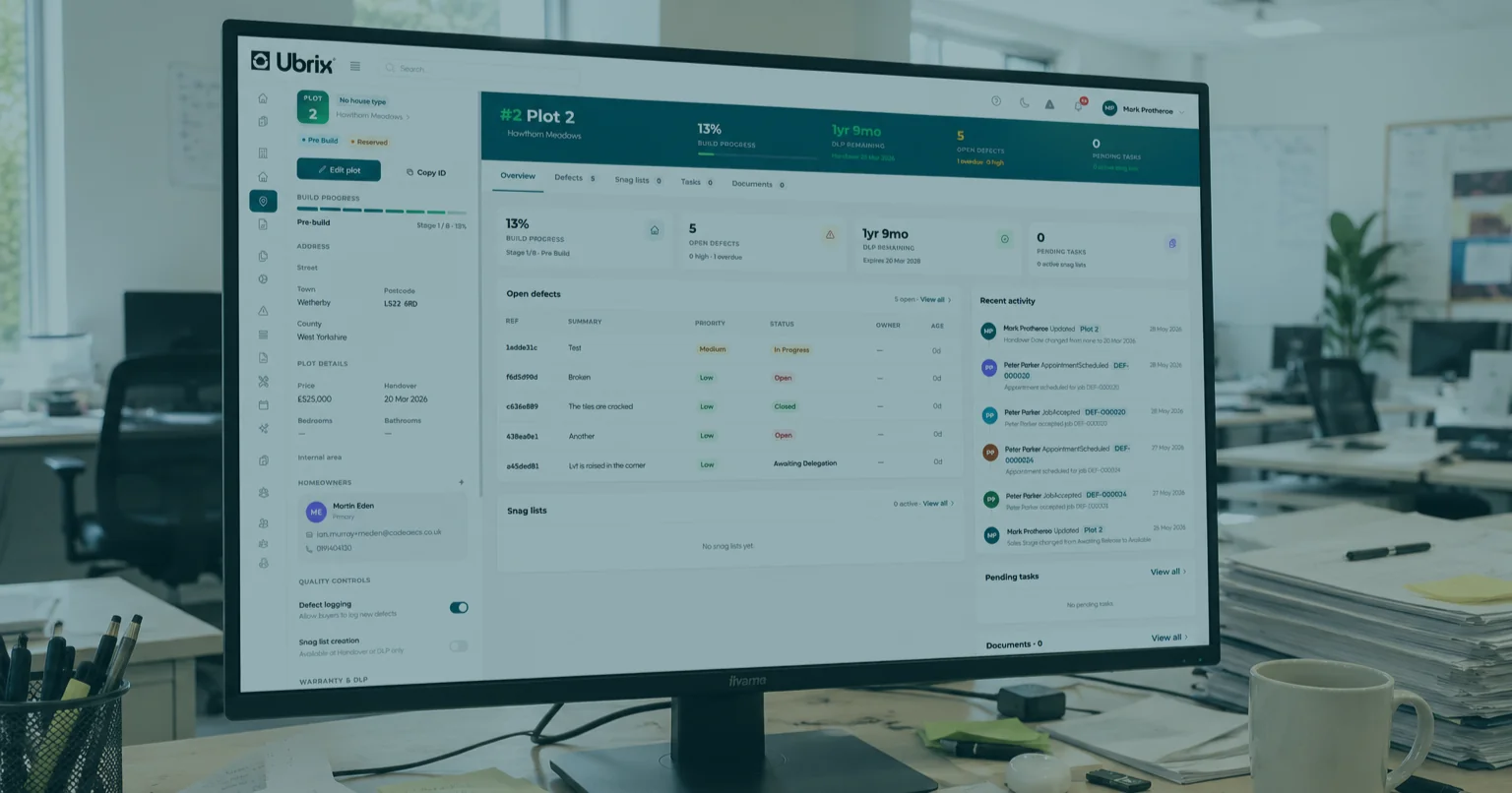
Ubrix connects the full buyer lifecycle in one platform, from reservation through sales completion, snagging, and aftercare resolution. That single connected record is the foundation. When an aftercare case is opened, the system already holds the buyer's reservation details, legal completion date, any pre-completion inspection notes, and every interaction logged through the Buyer App and Home Assist portal. There is no need to request information from sales, chase the site manager, or search through archived emails. The record is there.
Smart Triage is where inbound defect reports and complaints are handled. When a buyer submits an issue, or when a snag list arrives as an email or PDF, Smart Triage uses AI to read the content, extract each individual item, and assign a confidence score. Each item is categorised and routed with a clear evidence trail from the moment it enters the system. This matters because the alternative, a customer care coordinator manually reading a multi-page PDF and re-keying items into a spreadsheet, is slow, error-prone, and creates gaps in the record that become liabilities later.
Once Smart Triage has processed and categorised each item, Auto-Assign routes jobs to the correct contractor automatically through the Contractor Hub. The contractor receives the job, books an appointment, attends, and uploads evidence of completion, all within the same system. The aftercare team does not need to chase. The buyer can track progress through Home Assist. Every step is logged and timestamped.
For directors, Reporting and Integrations provides the portfolio-wide view that fragmented systems cannot deliver. Live dashboards show complaint volumes, resolution rates, open cases by site, and average time to close. This data connects to PowerBI for board reporting or HubSpot for customer relationship tracking. The result is that when a regional director is asked about aftercare performance at a specific development, the answer is available in seconds, not after a round of emails to site teams.
What changes for you
The first and most immediate change is speed. When an NHQC complaint or warranty claim arrives, the complete case history is available in seconds. Every buyer interaction, every defect report, every contractor visit, every piece of evidence uploaded through the Contractor Hub is already linked to that buyer and that plot. Your aftercare team responds to the complaint with a full timeline instead of a partial reconstruction. That speed directly affects outcomes, because adjudicators and warranty providers assess not just what you did, but how quickly and clearly you can demonstrate it.
The second change is how your aftercare team spends its time. In the fragmented model, a significant proportion of each working day goes to administrative archaeology: finding records, cross-referencing systems, confirming dates. With every interaction logged in one platform and every inbound defect processed through Smart Triage, that administrative burden drops sharply. Your team focuses on resolving issues, which is what reduces complaint volumes and improves buyer satisfaction scores.
The third change is at director level. Live visibility across every site means you spot trends early. If one development is generating a disproportionate number of aftercare cases in a specific trade category, you see it in the reporting dashboard before it becomes a pattern of formal complaints. If resolution times are drifting on a particular site, you see that too. This is the difference between reactive management, where you learn about problems from NHQC notifications, and proactive oversight, where you address issues before they escalate. For audit and compliance purposes, the traceability that Ubrix provides across sales, build, and aftercare means every buyer interaction is logged and available for NHQC, NHBC, Consumer Code, or Building Safety Act review.
Where to start
If your aftercare records currently live across three or more systems and you have experienced the two-day scramble to build a case file, the gap between where you are and where you need to be is clear. The question is whether you close it before the next complaint lands or after.
We are running short, focused demonstrations for directors who want to see how Smart Triage, Auto-Assign, and Reporting and Integrations work together in practice. No sales pitch. Just the workflow, shown against the kind of aftercare scenarios your teams deal with every week. Book a demo here and see what a connected aftercare record actually looks like.